FinGo Marketplace
Multi-vendor commerce platform with role-based merchant operations.
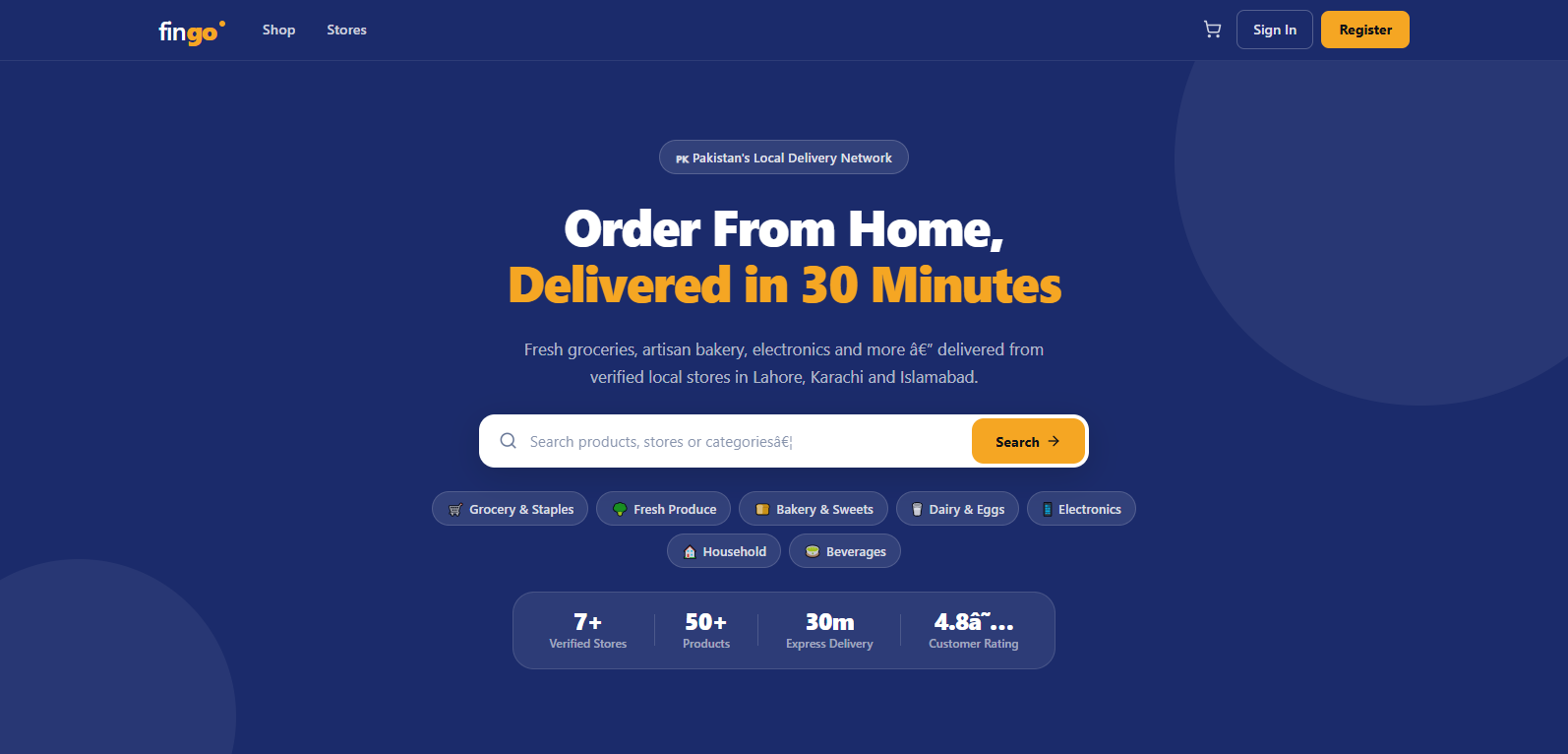
Verified merchants directory with city and category routing
System Overview & Engineering Longevity
A multi-vendor commerce platform built on the MERN stack (MongoDB, Express, React, Node.js) designed to connect merchants and consumers across Lahore, Karachi, and Islamabad. Engineered with a 3-tier Role-Based Access Control (RBAC) architecture separating Customer, Seller, and Admin portals. Features JWT authentication with refresh token rotation, dynamic store directories, multi-vendor cart splitting, and a full lifecycle order state machine.
Key Engineering Highlights
Architected with clean domain separation, strict TypeScript contracts, and automated telemetry logging.
Query Benchmark
Indexed MongoDB query response
Regional Coverage
Lahore, Karachi, Islamabad
Scoped RBAC Tiers
Customer, Seller & Admin
Transactional Cart
Atomic multi-store order splitting
End-to-End System Data Flow
How user inputs, computer vision pipelines, and transaction protocols flow across the stack.
Regional Geo-Routing
Shopper selects city (Lahore/Karachi/Islamabad); marketplace filters regional stores and delivery zones.
Multi-Store Cart Splitting
Cart partitions items into separate vendor fulfillment streams with independent sub-totals.
Order Creation Transaction
Database transaction commits customer order and generates individual merchant fulfillment tickets.
Vendor Dispatch State Machine
Merchants receive incoming orders and advance states: Confirmed → Packing → Dispatched → Delivered.
Admin Verification & Oversight
Admins audit store performance, resolve customer complaints, and oversee platform activity.
System Capabilities & 6+ Functional Modules
3-Tier RBAC Portal Architecture
Granular permission separation providing customized UI and API scopes for Customers, Merchant Sellers, and Platform Administrators.
Order Splitting & State Machine
When a customer purchases items from multiple distinct merchants in a single checkout, the backend partitions the transaction into independent merchant orders with individualized status tracking.
City-Based Filtering Directory
Regional filtering enabling shoppers to browse stores and merchants based on city location (Lahore, Karachi, Islamabad).
JWT Authentication & Refresh Token Rotation
Authentication using short-lived access tokens paired with secure HTTP-only refresh tokens rotated in the background.
Merchant Catalog & Inventory Management
Vendor management suite enabling merchants to create product listings, upload imagery, configure variants, manage inventory counts, and toggle promotional deals.
Admin Compliance & Merchant Verification
Administrative review tools to verify merchant information before stores are permitted to sell publicly.
Key Engineering Bottlenecks & Solutions
Multi-Vendor Order Partitioning Without Inconsistencies
When a single customer cart contains items from multiple stores, a partial failure could cause inventory anomalies. Engineered a database transactional pipeline that commits all sub-orders or rolls back if any store inventory is depleted.
Secure Session Persistence Across Refresh Cycles
Storing tokens in localStorage exposed credentials to XSS vulnerabilities. Implemented a dual-token architecture: short-lived access tokens stored in memory paired with HttpOnly refresh cookies rotated on API requests.
Catalog Search Efficiency Across Large Catalogs
Built compound indexes on MongoDB collections (city + category + price) and debounced search inputs, keeping catalog query benchmark times around 45ms in development testing across product records.
Evershine Academy ERP & LMS
Multi-campus educational ERP & LMS featuring live biometric fingerprint integration, 7-role portals & automated finance engine.